

When we talk about trailblazers in civil engineering, one name often comes up: Dorothy Donaldson Buchanan.
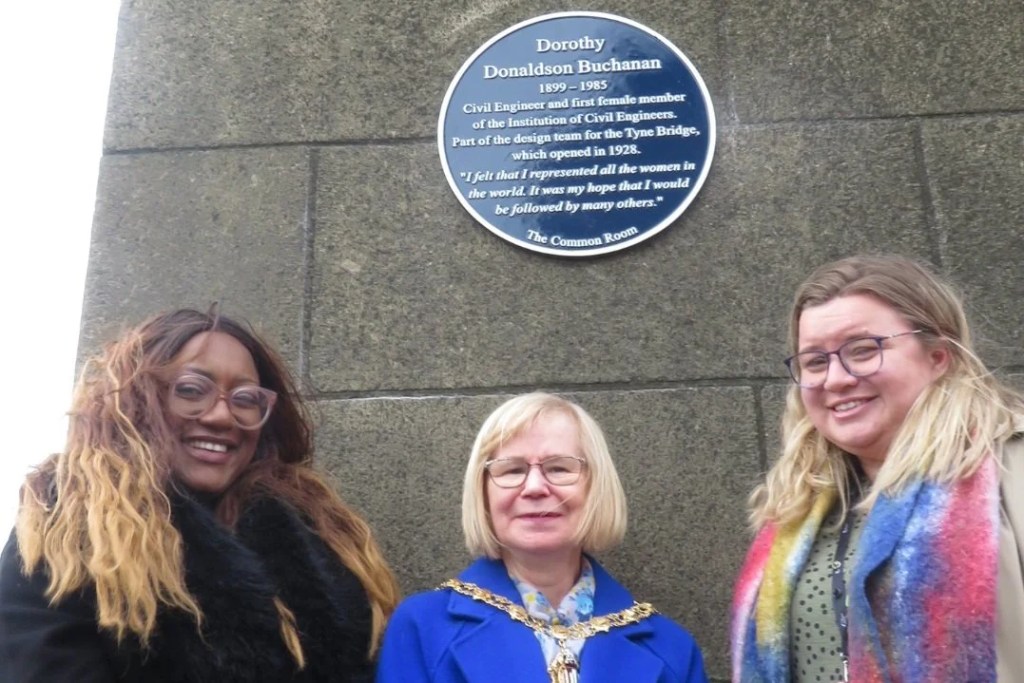
In 1927, she became the first woman to qualify as a Chartered Civil Engineer.
Reflecting on her achievement, she famously said:
“I felt that I represented all the women in the world. It was my hope that I would be followed by many others.”
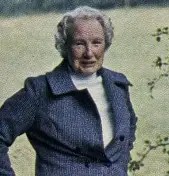
Her words capture the weight of responsibility she carried and the hope she held for future generations.
But have you ever heard of Dr Helen Grimshaw?
The Forgotten Pioneer
During the First World War, women stepped into engineering and technical roles out of necessity. By the 1920s, many had proven their capability, yet professional institutions still barred them from membership.
Helen Grimshaw, born in London in 1904 and raised in Surrey, was the daughter of a civil engineer. In 1924 she began studying civil engineering at University College London (UCL). It was one of the few universities at the time that admitted women into engineering courses. Armed with academic credentials, she applied for student membership of the Institution of Civil Engineers (ICE).
At that time, the ICE’s rules did not specifically include women. Helen’s application in late 1924 directly confronted this.
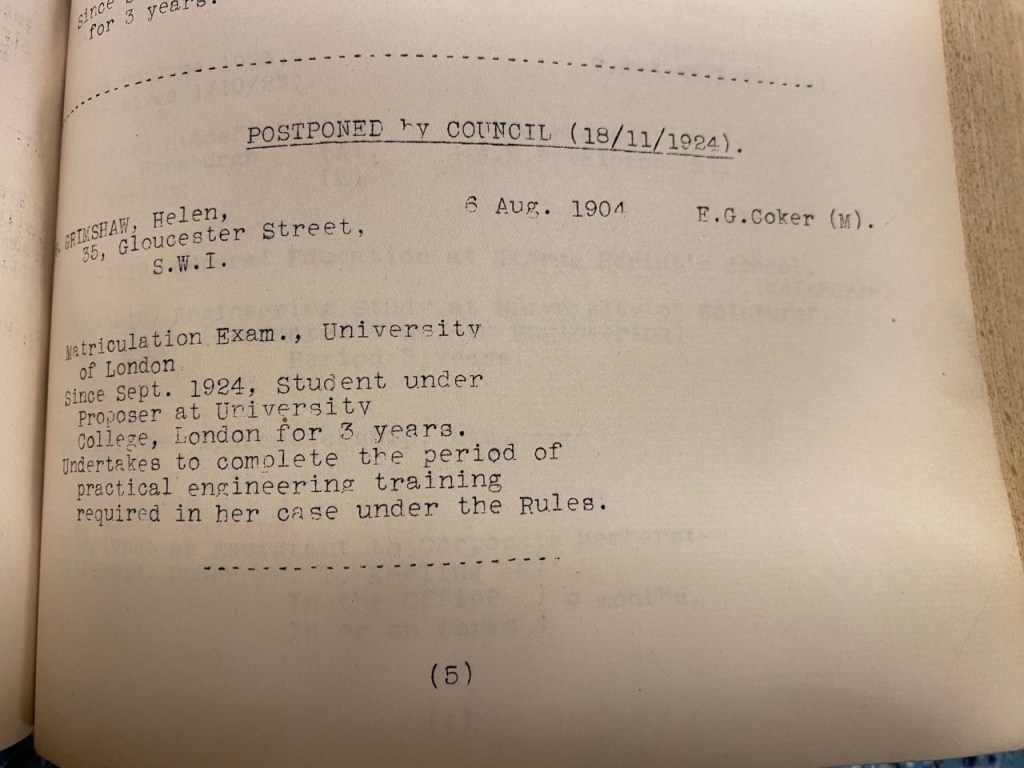
Helen’s application is mentioned in the council meeting’s minutes from 18 November 1924 where it was postponed (until January 1925).
She was already a member of the Women’s Engineering Society (WES) founded in 1919. This connected her to a wider movement pressing for equality in professional recognition.
Meanwhile, Dorothy Donaldson Buchanon was already making her mark in industry. She had graduated with a BSc in Civil Engineering from Edinburgh University in 1923. Fresh from this achievement, she was hired in April 1924 by Sir Ralph Freeman. He was the senior partner at Douglas, Fox & Partners. Freeman was consulting for Dorman Long. He placed Dorothy in their London office as part of the bridge design staff. Her pay was £4 per week plus overtime, the same as her male colleagues, a rare gesture of parity in that era. By 1925, Dorothy was involved in the structural design work for the Sydney Harbour Bridge. Like Helen, she joined WES while still at university.
But most importantly, at this stage Dorothy was not a member of the ICE. In 1927, after seeing her colleagues apply, she finally submitted her application for an associate member. At the time, this was the step that conferred Chartered status.
The Debate That Changed History
Helen’s application triggered a formal debate in council after legal advice was sought.
- Application considered: Helen Grimshaw’s request for student membership was presented to the Council for the second time (postponed from a November 1924).
- Rules at the time: ICE’s by‑laws did not include women, so her case required a ruling.
- Debate and consideration of the Sex Discrimination (Removal) Act of 1919.
- Decision: On 13 January 1925, the Council voted to accept Helen Grimshaw’s student membership application following legal advice, making her the first female member of the ICE.
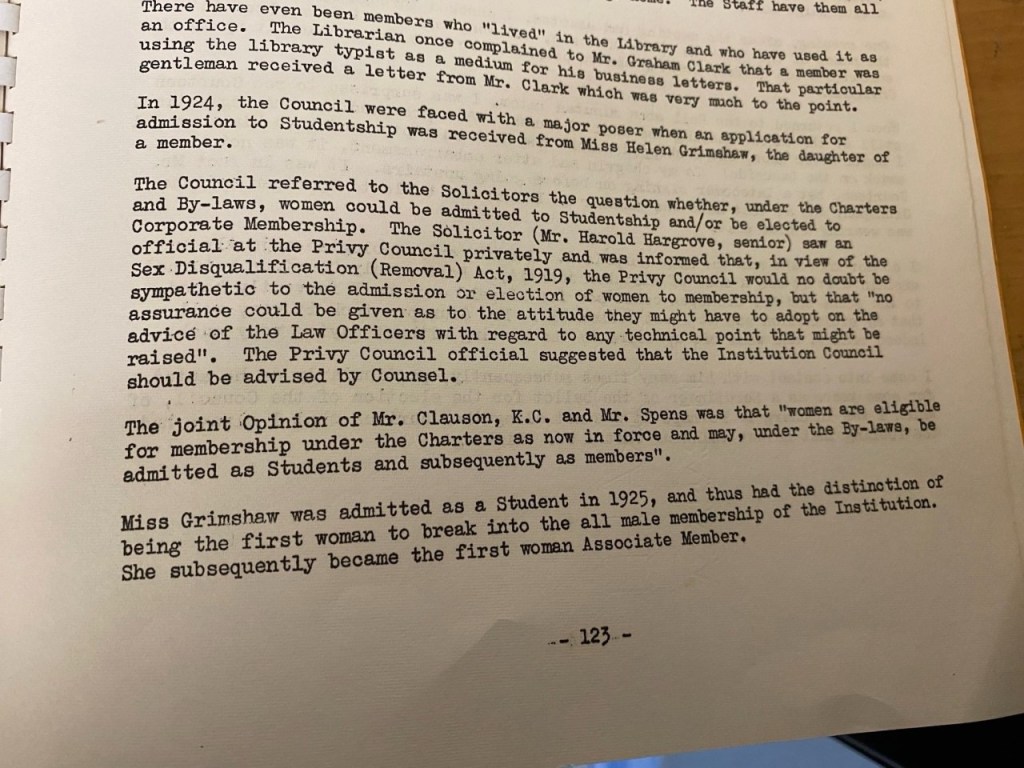
1925 Institution of Civil Engineers: Members Elected – Graces Guide
Her success was celebrated in The Woman Engineer journal, which proudly announced:
“Miss Helen Grimshaw, an Associate Member of the WES, has had the distinction of being the first woman to enter this institution. She has been admitted as a student member, being in her first year at University College, London…”
Courtesy of The Woman Engineer journal archives
Beyond Civil Engineering
Although Helen Grimshaw never practised as a civil engineer (she was removed from the student roll in 1930); she carved out a remarkable career in aeronautical engineering at the Royal Aircraft Establishment (RAE). She became a pioneer in human engineering and pilot safety, contributing to advances in de‑icing systems, oxygen equipment, parachutes, and pressure suits.
Engineer of the Week Series – Magnificent Women
From 1941, Grimshaw took charge of flight test programmes, and in 1947 she achieved her first solo flight in a twin‑engined Oxford aircraft as part of the RAE Technical Training Flight. By 1961, she had risen to the role of Project Officer, leading the development of the full pressure suit. In this position she oversaw technical monitoring of suit development in industry and directed associated investigations at RAE.
Her groundbreaking work earned her some of the highest honours in her field: the Wakefield Gold Medal (1966) and an OBE (1969), recognising her lasting impact on aviation safety and engineering innovation.
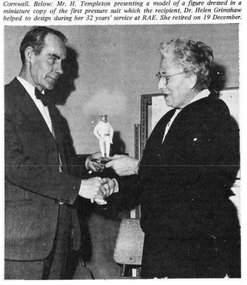
She also remained a lifelong member of WES.
Why Her Story Matters
Helen Grimshaw’s membership of the ICE was truly historic. She challenged the Institution’s exclusionary policy. By doing so, she opened the door for Dorothy Buchanan and others to follow..
Though she may not be as widely remembered, Grimshaw’s courage and persistence changed the course of civil engineering history.
Alongside her remarkable career in aeronautical engineering, where she earned both the Wakefield Gold Medal and an OBE, Dr Helen Grimshaw should also be honoured as the woman who walked so Dorothy could run.
She was the first woman to apply and be admitted into the Institution of Civil Engineers.
Their stories remind us that progress often begins with those who dare to challenge the rules, opening doors not only for themselves but for generations to come.

Thanks for reading.
 meshikiyang.com
Leave a comment