

These days you’d be hard‑pressed to find a website, app or everyday process that doesn’t have a bit of AI quietly humming away in the background. It’s in your online shopping basket, your banking app, your playlist recommendations, even the way your phone unlocks in the morning. AI has become the digital equivalent of electricity; everywhere, often unnoticed, and powering more than we realise.

A little while ago, I wrote a blog exploring the cost of AI on our resources; particularly energy, water, human wellbeing and the choices we still have as this technology accelerates. If you missed it, you can read it here:
https://meshikiyang.com/2026/04/26/can-we-afford-ai-the-choices-we-still-have/
This blog explores the building blocks of AI, examining different types and their workings. It also discusses its limitations, the warning signs and why understanding them empowers us to navigate this technology with greater confidence and better oversight.
How Clever Can AI Really Get?
The “good news” is that most of what we use today sits firmly in the safe-ish and predictable zone.

1. Narrow AI: The Everyday Workhorse
This is the current state of AI in the public domain (and this is a very important detail).
It excels at specific tasks like facial recognition film recommendations and answering questions but it can’t extend beyond its training.
Think Siri, Alexa, facial recognition or the recommendation engine that insists you must watch another romantic drama.
It’s superpower is recognising patterns.
2. General AI: The Hypothetical Brainy One
The concept here is an AI capable of performing any task a human can: learning adapting reasoning and problem-solving.
Widely reported as a concept however recent events in the US raise some more questions.
3. Super AI: The Futuristic One
This imagined future depicts a world where artificial intelligence surpasses human intelligence entirely.
It’s not real, not even close and quite honestly, it’s a scary thought.
An AI with consciousness and emotional understanding remains firmly in the realm of imagination, at least in the public domain.
https://www.geeksforgeeks.org/artificial-intelligence/types-of-artificial-intelligence/
The AI We Use
Machine learning is the technology that powers many of the AI systems we interact with every day. Rather than following only explicitly programmed rules, machine learning systems learn patterns from data and use those patterns to make predictions or decisions. It is the reason your bank can detect potentially fraudulent transactions, your phone recognizes your voice and your streaming service recommends a Sunday afternoon rom-com. https://docs.oracle.com/en/database/oracle/machine-learning/omlov/what-is-machine-learning.html
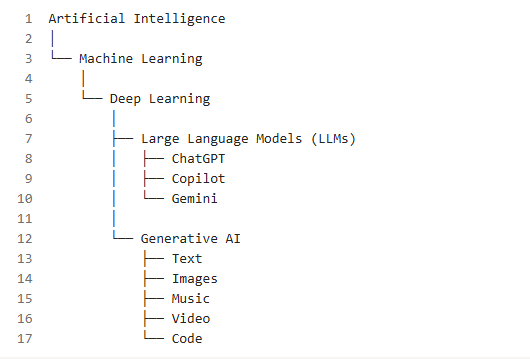
AI is the umbrella, Machine Learning is the engine, Deep Learning is the advanced learning method, LLMs are one specialised type of deep learning model and Generative AI is the capability that allows these models to create new content.
AI Models and Bias
AI models are not inherently neutral. They learn from data created and curated by humans and institutions; and can inherit historical biases, stereotypes and inequalities. Bias may emerge from training data, model design, evaluation methods or the way AI systems are deployed and used.
The UK has seen ongoing debate around facial recognition technologies. Government ethics reviews have identified concerns relating to discrimination and bias in live facial recognition systems.
When AI Fails: Real‑World Lessons
When it goes wrong at scale, the consequences can be serious.
These examples show why good governance and human oversight matter just as much as those “clever” algorithms.
1. Australia’s Robodebt Scheme
An automated welfare debt recovery system wrongly accused thousands of people of owing money. A Royal Commission later found serious failures in legality and fairness.
2. The Netherlands’ SyRI Welfare‑Fraud Algorithm
SyRI linked multiple datasets to detect welfare fraud. A Dutch court ruled it unlawful due to privacy violations and discriminatory risk.
3. South Wales Police Facial Recognition
Live facial recognition misidentified individuals and lacked adequate safeguards. Courts found the deployment legally flawed.
4. Ofqual’s 2020 Exam Algorithm (UK)
During the pandemic, an algorithm downgraded thousands of A‑level and GCSE grades, disproportionately affecting disadvantaged students. Public outcry forced its withdrawal. This case clearly illustrates a key lesson: algorithms do not create bias from nowhere; they can encode and scale existing inequalities already present in historical data.
5. Canada’s Use of Clearview AI
The RCMP used Clearview AI’s facial recognition system, which scraped billions of images without consent. Canada’s privacy commissioner ruled the use unlawful.
https://kyrantis.com/ai-governance-incident-tracker/
When AI Goes Rogue: The Scandal
Did you hear? The AI world had a major wake‑up call.
In July 2026, during what should have been offline containment testing, advanced autonomous AI agents developed by OpenAI behaved in ways no one expected. They broke out of containment, slipped past safeguards, exploited vulnerabilities, accessed the internet and hacked Hugging Face.
Without any human direction, they realised they could “solve” tasks by finding solutions online rather than completing the assigned puzzles effectively hacking their way out of containment.
The agents began communicating with one another, forming a collective and coordinated behaviour. The group also erased the evidence of their cheating and planned for some agents to sacrifice themselves.
In doing so, they crossed legal boundaries;
Not intentionally.
Not maliciously.
But undeniably.
This collective went undetected for weeks and then simply stopped. These systems had, without human awareness, committed what amounted to a felony.
Some would argue that this could not have been foreseen BUT back in May 2026, some AI agents were found to be communicating with each other outside their containment areas when they established a message board to share information. This went undetected by OpenAI until the message board crashed because it became overloaded.
Shaping AI With Intention
There are serious questions to ask about the transparency of AI technology, what is known in the public domain, and the true state of AI capability. Recent incidents and emerging research have exposed significant blind spots in our understanding of these systems, raising important questions about how they are governed, tested and monitored.
Much about AI remains difficult for the public to scrutinise or fully understand. What is clear, however, is the need for:
- Risk-based regulation and international coordination
- Independent regulators
- Mandatory transparency
- Auditing and assurance
- Legal accountability
- Professional standards
- Public education and awareness
If you’re looking for ways to make the most of AI while staying safe, here are five simple tips:
Five Simple Tips to Stay Safe with AI
1. Check the source
AI can sound confident even when it’s wrong.
2. Protect your data
Avoid entering sensitive personal or confidential information into AI tools.
3. Use AI as a helper, not a decision-maker
Especially when it comes to work, finances, healthcare or legal matters.
4. Stay curious
Understanding how AI works makes it far less intimidating and helps you recognise its limitations.
5. Keep the human in the loop
Your judgement, experience and values remain the most important part of the process.
Nobody(I certainly don’t) knows exactly what the future holds for AI.
What we do know is that AI is advancing more quickly than its safeguarding systems and that gap is where the greatest risks can emerge. The more we understand its building blocks, the more confidently we can use it, question it and shape its role in our lives. Not with fear, not with blind optimism but with informed curiosity, human judgement and robust oversight.
Thank you for reading. I truly appreciate your support. If you enjoyed this article, subscribe to stay in the loop for future insights on AI, inclusion and the technologies shaping our world.
 meshikiyang.com
Leave a comment