
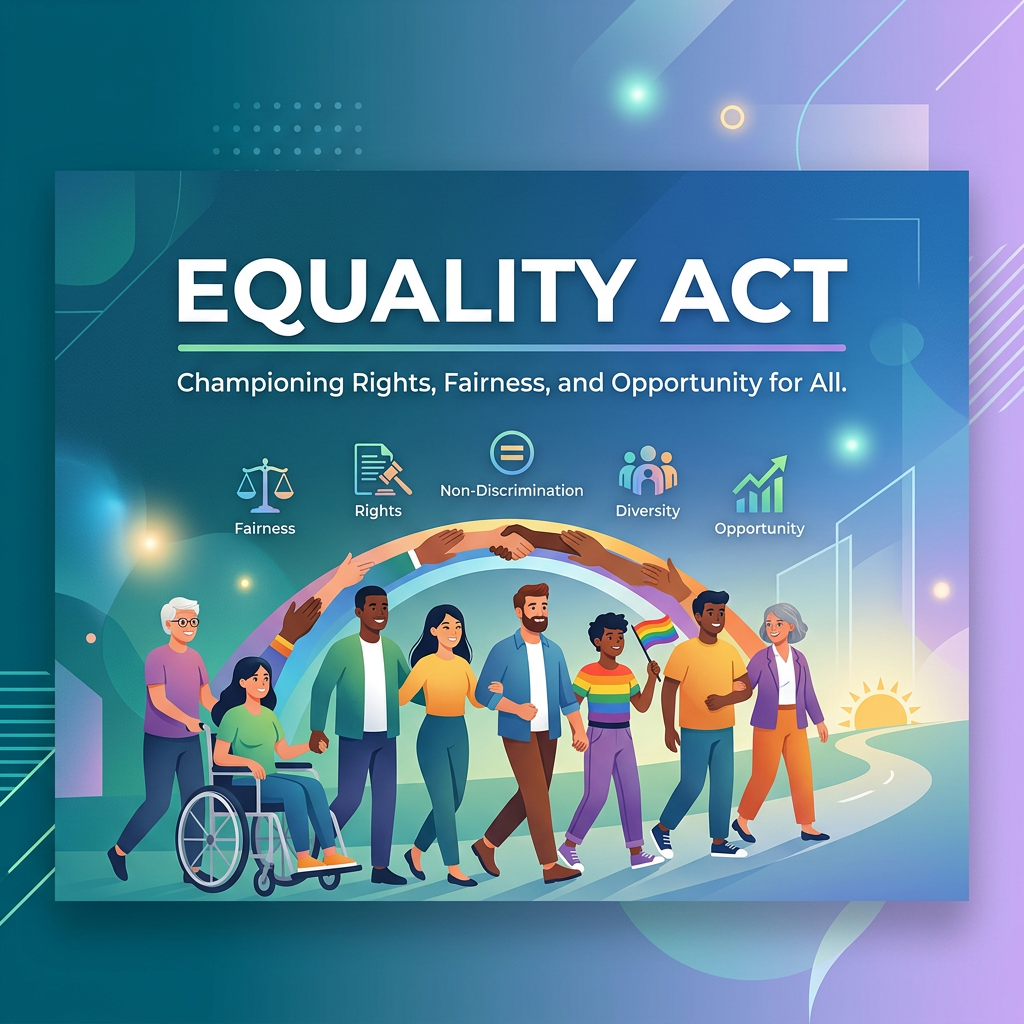
Few laws attract as much debate and misunderstanding as the Equality Act. Yet many of us only meet it through a mandatory e-learning module during induction. We click through slides on protected characteristics, harassment and discrimination, absorb the basics, pass the quiz and move on.
What we rarely do is step back and look at the Act as a whole.
- Where did it come from?
- What was it trying to fix?
- How has it changed?
- Why does it still matter in a world that looks nothing like 2010?
Once you trace its history, the story becomes far more interesting and far more human.
Is the Equality Act an EU Legacy? Not Quite
A common myth is that the Equality Act is a leftover from EU membership.
The reality is more nuanced.
UK equality law is built on three foundations:
- long standing domestic law
- EU directives that set minimum standards
- international human rights treaties
The Equality Act is fundamentally a British creation, it consolidated over 40 years of UK legislation.
EU law influenced parts of it but the UK often went further. The Disability Discrimination Act (1995), for example, pre dated EU disability protections (2000) by years.
After Brexit, the UK chose to retain many EU derived principles to avoid weakening rights.
So the Act is British in origin, European in influence and international in spirit.
A Century of Change: Where It All Began
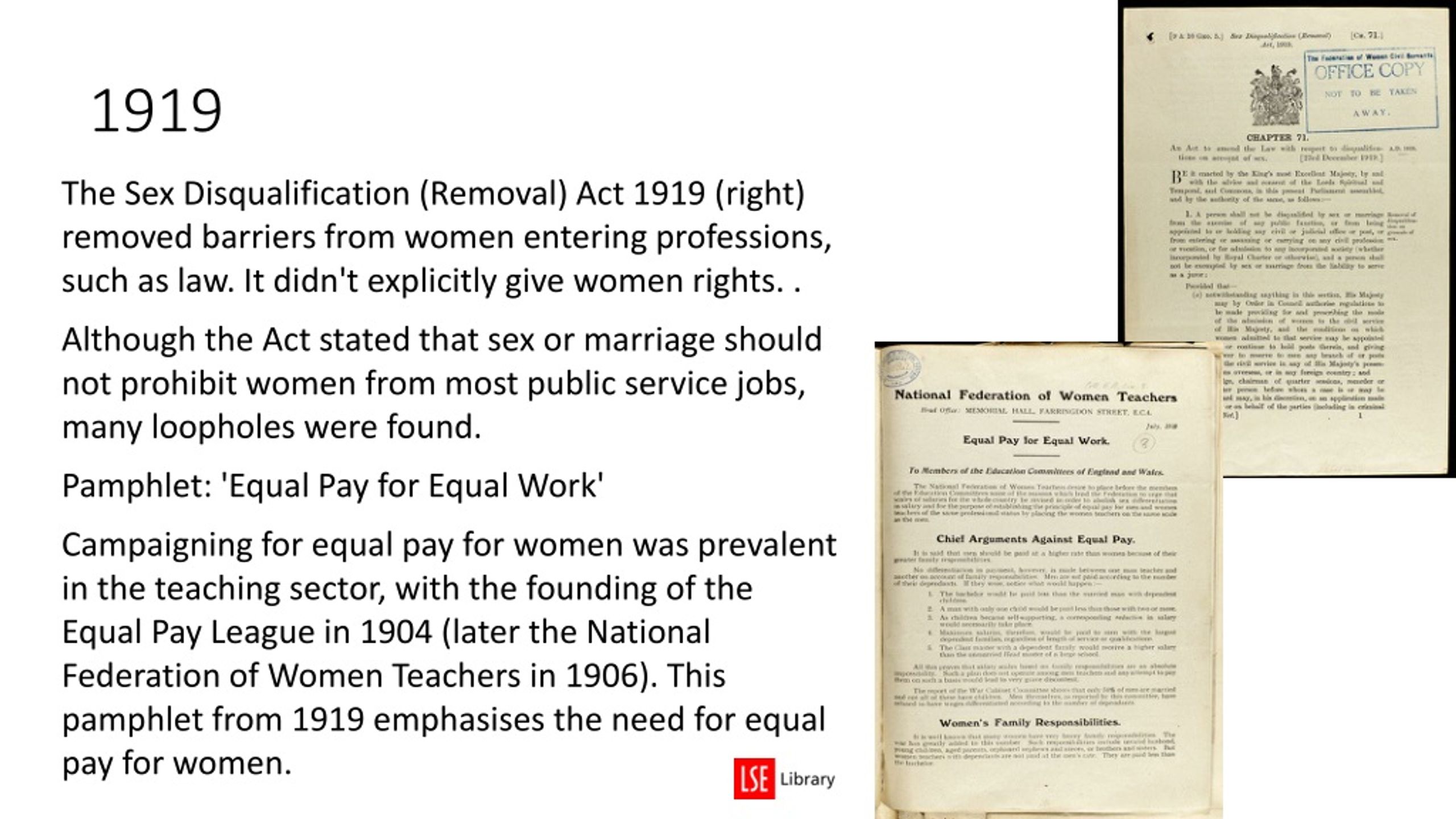
To understand the Equality Act, you have to go back to 1919.
Britain was reshaping itself after the First World War. Women had stepped into roles previously closed to them engineering, transport, manufacturing, public service only to be pushed out when men returned from the front.
Many refused to accept that reversal. The world had changed and they were not going back quietly.

That same year, Parliament passed the Sex Disqualification (Removal) Act 1919. Despite its clunky name, it opened doors for women to enter professions like law, accountancy and the civil service.
It was not perfect, but it was a start.
Over the decades that followed, more laws arrived:
- Race Relations Acts 1965, 1968, 1976.
- Equal Pay Act 1970.
- Sex Discrimination Act 1975.
- Disability Discrimination Act 1995.
- Employment Equality Regulations in the 2000s.
Piece by piece, the UK built a patchwork of protections.
By the late 2000s, the landscape was powerful but messy with overlapping duties, inconsistent definitions and gaps that left people unsure of their rights.
The Equality Act 2010 brought all of this together.
What the Equality Act Actually Does
The Act did not invent equality law, it unified many.
It protects people from discrimination in work, education, services, housing and public life across nine protected characteristics.
- age
- disability
- gender reassignment
- marriage and civil partnership
- pregnancy and maternity
- race
- religion or belief
- sex
- sexual orientation
These protections apply to everyone, there is no hierarchy of worthiness.
A young white man stereotyped as too “laddish” is protected. A Black woman repeatedly passed over for promotion is protected. A pregnant worker sidelined is protected. A disabled employee needing adjustments is protected.
Race protections apply to all racial groups. Sex protections apply to men and women. Age protections apply to younger and older people.
The Equality Act is not a system where one person’s gain means another’s loss.
It is a framework for fairness.
Why the myths are spreading
Misunderstandings flourish because the equality act is often discussed through headlines, politics and social media soundbites; and the difference between positive action and positive discrimination is rarely explained well.
This blog aims to cut through that noise.
Myth 1: “The Act only protects certain groups.”
Reality: It protects everyone.
The law is symmetrical. Anyone can experience discrimination and anyone can bring a claim.
Myth 2: “Positive action means hiring less qualified people.”
Reality: This is misinformation.
Positive discrimination and positive action are not the same.
Positive discrimination is choosing someone because of their protected characteristic. This is unlawful. Section 13 of the Equality Act prohibits treating someone less favourably because they do not have a protected characteristic. That is the legal mechanism that makes positive discrimination unlawful.
Positive action, on the other hand, is about removing barriers. It includes outreach, mentoring, targeted development and leadership programmes. It is levelling the field, not tilting it.
Positive action is voluntary and so is reporting it. Only public sector bodies such as NHS trusts, local authorities, government departments and universities must publish annual equality information under the Public Sector Equality Duty. Even then, they are not required to report positive action specifically.
How does positive action work?
1. Identify a real, evidence based disadvantage Employers must have reasonable evidence that a group is under represented or faces barriers.
2. The action must be proportionate Interventions must be reasonable and balanced. Examples include mentoring, outreach or targeted development.
3. It must not become positive discrimination No quotas. No automatic preference. No selecting someone because of their protected characteristic.
4. Recruitment has an extra rule: the tie break Under Section 159, employers can choose a candidate from an under represented group only if they are genuinely equally qualified, there is no automatic policy and the step is proportionate.
The tie‑break is:
- very narrow,
- difficult to apply,
- rare in practice,
- and often avoided due to legal risk.
In practice, the tie break is almost never used. FOI requests to NHS trusts, local authorities, police forces and universities show the same answer: they have not applied it.
- The tie‑break is lawful but almost never used.
- There is no evidence of widespread or routine application.
- There is no data suggesting it has influenced hiring patterns at scale.
- Most employers rely on general positive action (Section 158) instead, which is far broader and safer.
Positive action in the workplace – GOV.UK
Myth 3: “The Act is outdated and needs scrapping.”
Reality: The Act is evolving, not eroding.
Recent changes strengthen maternity protections and introduce a new duty to prevent workplace sexual harassment. The 2023 amendments expand Section 18 to give clearer protection during and after pregnancy. The Worker Protection Act, which came in effect in October 2024, requires employers to take reasonable steps to prevent sexual harassment before it occurs.
The direction of travel is clearer standards, not weaker ones.
Reasonable Adjustments: Designed for Some, Beneficial for All
One of the most transformative parts of the Act is the duty to make reasonable adjustments for disabled people. Around a quarter of the UK population has a disability visible or invisible and adjustments are often the difference between exclusion and participation.

But adjustments designed for disabled people often end up improving life for everyone. Voice activated tech, subtitles, automatic doors and flexible working all began as adjustments. This is the curb cut effect when you design for those facing the biggest barriers, you create better environments for everyone.
So Where Do We Go From Here?
The real conversation is not about scrapping the Equality Act. It is about evolving it.
Our workplaces, communities and identities are changing. Technology is reshaping how we live and work. New forms of discrimination emerge as old ones fade. And the law, as always, has to keep pace.
The Equality Act is not perfect. No law is. But it remains one of the most powerful tools we have for creating a fairer society not by pitting groups against each other but by setting a shared standard of dignity, respect and opportunity.

The question is not whether the Act should be scrapped.
It should be how we continue to shape it for the present and the future.
Thank you for reading and don’t forget to subscribe!
 meshikiyang.com
Leave a comment