
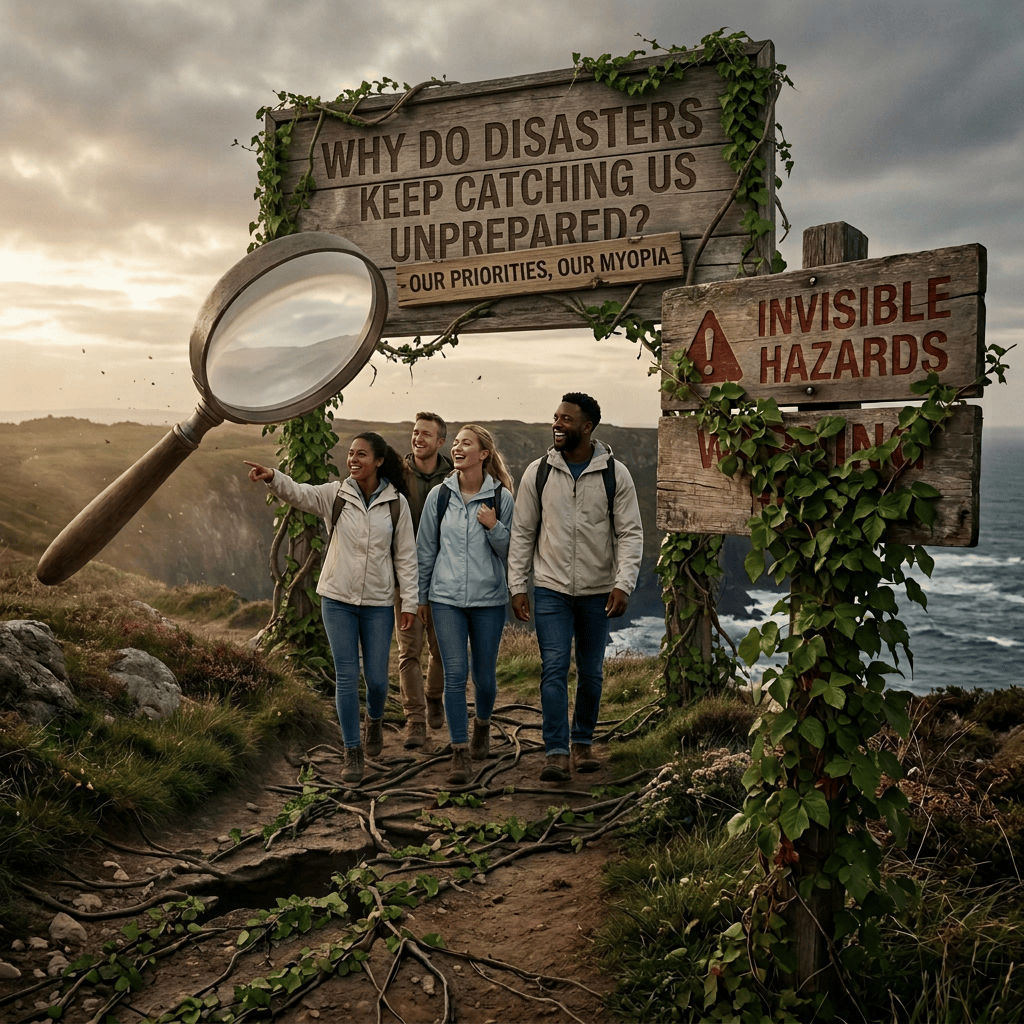
It often feels as though we are watching an endless stream of disasters unfold around the world. One week it is homes swept away by sudden floods, the next it is families displaced by storms or droughts that linger far longer than expected. Once the flood season passes or the drought breaks; the news cycle moves on, our attention shifts and resilience slips quietly into the background.
So let me ask you something.
Do you have a plan for your home or your family if a flood hit your street tonight?
The UK Public Survey of Risk Perception, Resilience and Preparedness was conducted earlier this year. From a sample of over £10,000 UK adults, its findings identified gaps in awareness and preparedness against emergencies/disasters.
The majority (68%) of survey respondents thought that the number of emergencies/disasters would increase in the next 10 years.
UK Public Survey of Risk Perception, Resilience and Preparedness 2026: GOV.UK
The 2022 report “Every Time it Rains” by the British Red Cross also highlighted low levels of awareness about flood risk and knowledge of how to prepare for and respond to flooding, particularly in areas with high social vulnerability.
What lessons do we learn from human disasters and more importantly when will we learn them in time?
I have been asking myself this a lot lately.
What Human Disasters Teach Us
The pace of climate change is accelerating yet our systems of decision-making remain locked into old patterns. The impact of climate denial at leadership level slowing progress and positive impact nowhere near the ambitions set out in the UN Sustainable Development Goals.
The latest UN SDG Progress Report highlights the stark picture.
- Only fifteen percent of targets are on track.
- Nearly half are moderately or severely off track.
- More than one third have stalled or reversed.
“…just 36 per cent of the 139 assessable SDG targets are on track or making moderate progress, and 15 per cent have gone into reverse” – The-Sustainable-Development-Goals-Report-2026.pdf
With less than five years to go, without urgent course correction the world will miss most of the 2030 goals.
We are living through rising temperatures, record-breaking floods and droughts, and growing water insecurity. Yet the systems designed to protect people and nature are not keeping pace with the scale or speed of change.
This gap between what we know and what we do is not new. History shows us the same pattern time and again: warnings missed, risks underestimated or deprioritised, hazards ignored, and action arriving too late.
Some of the greatest threats are not the ones we can see. They develop quietly, accumulate over time, and remain largely unnoticed until a tipping point is reached.
Let me tell you the story of the Lake Nyos disaster.
A Lake Not Like The Others
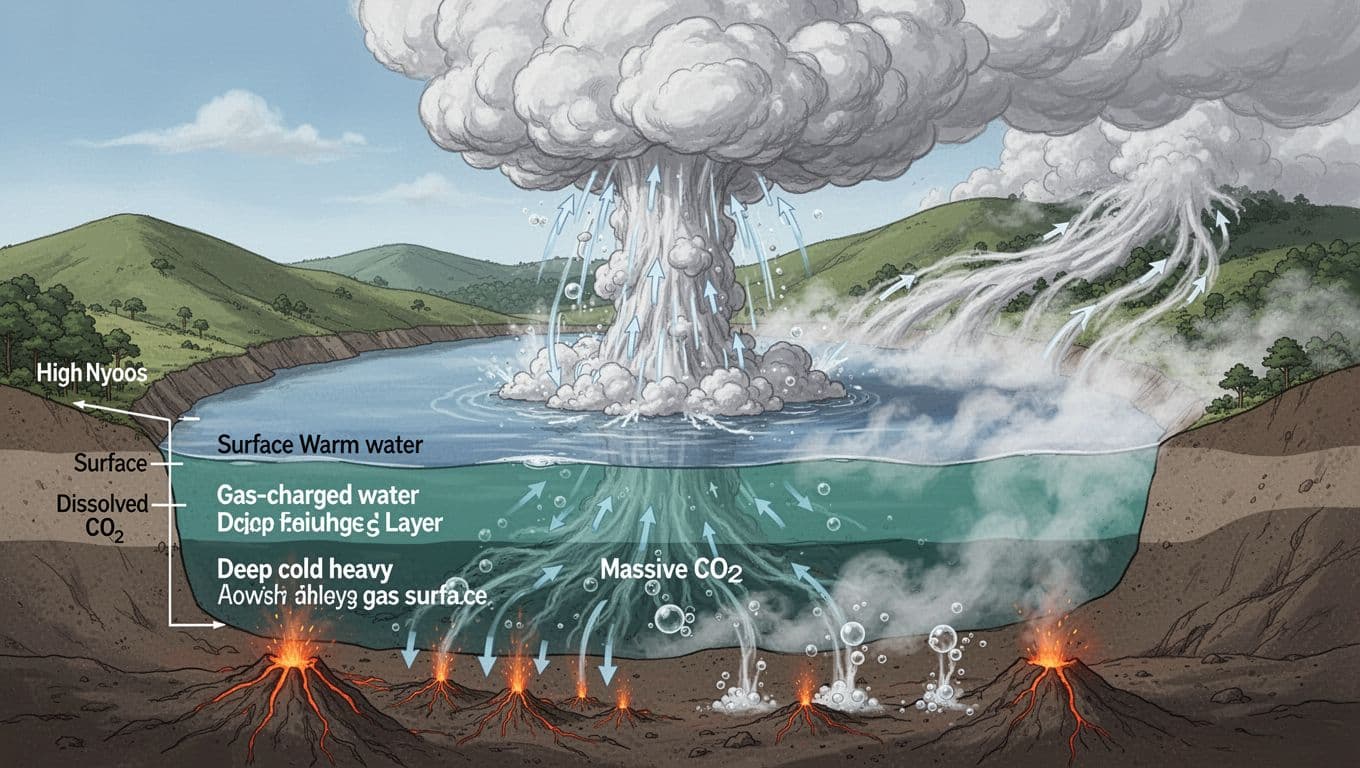
Lake Nyos is a deep volcanic crater lake in Cameroon. It is one of only three lakes in the world known to contain large quantities of dissolved carbon dioxide. Two of them, Lake Nyos and Lake Monoun, lie within the same volcanic region, the Oku Volcanic Field, just 100 kilometres apart.
The third, Lake Kivu on the border of Rwanda and the Democratic Republic of the Congo, is around 1,700 times larger than Lake Nyos and sits beside a densely populated region. If a limnic eruption occurred there, the lives of around two million people could be at risk, which is why the lake is closely monitored.
Three characteristics make them distinctive:
- They sit above pockets of magma where carbon dioxide seeps upward into the deep water.
- Their layers do not mix leaving dense gas rich water trapped at the bottom.
- They are prone to limnic eruptions where extreme gas saturation can trigger a sudden overturn of the water column.
The Night an Entire Valley Never Woke Up
Some dates imprint themselves on us, like 11 February 1990 when Nelson Mandela walked free. Other dates shape us quietly, even if the world barely noticed.
On 22 August 1986, as much of the world was waking up for another day, a valley in Cameroon remained silent. Entire villages across the valley lay still; no birds, no voices and no movement.
The deadliest limnic eruption ever recorded had occurred overnight.
In one night, entire communities were wiped out.
I was a child so my memory of the news is hazy but we learned about it in school and the annual remembrance helped me better understand its scale and its significance.
The Eruption That Changed Everything
On 21 August 1986, Lake Nyos released a massive cloud of carbon dioxide that suffocated more than 1,700 people and thousands of animals within minutes. Survivors recalled a sound like distant thunder before an invisible catastrophe swept silently through the valley.

An estimated 1.6 million tonnes of carbon dioxide burst from the lake, spilling over the crater rim and flowing downhill like an avalanche. Because the gas is heavier than air, it hugged the ground, displacing oxygen and causing rapid asphyxiation.
Most victims died in their sleep. Entire villages were wiped out within a 25-kilometre radius. Those on the edges who survived faced burns, respiratory distress, neurological symptoms, trauma, displacement and long-term socioeconomic loss.

The government declared the valley a no-go zone, and survivors were displaced to refugee camps and resettlement villages, leaving behind homes, livelihoods and communities that many would never return to.
The Warning We Failed to Learn
What makes Lake Nyos especially tragic is that it was not the first warning.
Two years earlier, Lake Monoun had erupted in a remarkably similar way.
Thirty-seven people died.
Scientists recognised the danger.
Yet little changed.
In hindsight, Lake Nyos was not simply a natural disaster.
It was a known risk that remained insufficiently understood, communicated and addressed.
What Lake Nyos Looks Like Today
Today, the area surrounding Lake Nyos appears peaceful. Nestled within a quiet highland basin, it is framed by green slopes and dense vegetation, with still waters reflecting an almost ordinary calm. Nothing in the landscape hints at the horror of the night when an entire valley fell silent. Yet the lake is continuously monitored and degassed, a reminder that the danger has not entirely disappeared.
The crater rim remains intact, the forests have reclaimed the hillsides, and the lake rests quietly beneath the surrounding mountains. Beneath this serene surface, however, carbon dioxide continues to accumulate in the depths. Degassing pipes safely vent the gas before it can build to dangerous levels, transforming an invisible threat into a carefully managed risk.
Lake Nyos stands as a powerful lesson in how nature can conceal extraordinary danger behind an appearance of tranquillity. Its calm waters remind us that some of the greatest risks are not the ones we can see, but those hidden beneath the surface.
Invisible Hazards of Today
The story of Lake Nyos is not just a historical tragedy.
It is a mirror.
It reflects how societies respond to invisible hazards: threats that develop quietly beneath the surface while attention remains elsewhere.
Today one of the most significant examples is groundwater depletion.
According to the United Nations World Water Development Report, groundwater accounts for 99% of all liquid freshwater on Earth.

It supplies around half of global domestic water use and supports a substantial proportion of irrigation and food production.
World enters era of ‘global water bankruptcy’ | UN News
Yet groundwater depletion is accelerating. In many regions, extraction rates now exceed natural recharge, creating what some experts describe as an era of global water bankruptcy.
As freshwater reserves shrink, countries must prepare for a new water reality | UN News
Groundwater remains poorly understood, undervalued, mismanaged and increasingly overexploited. Once contaminated, it can be extraordinarily difficult and expensive to restore. Once depleted, recovery may take decades, if it occurs at all.
In the United Kingdom, seasonal droughts provide a recurring warning. Water companies often face scrutiny when shortages emerge, yet the quieter problem underlying many of these challenges, the gradual depletion and degradation of groundwater resources, rarely receives the same level of public or political attention.
The 2022 report, Groundwater: Making the Invisible Visible, offers an accessible introduction to one of the world’s most important yet overlooked resources and the challenges threatening its future.
Why Education Matters
Invisible hazards rarely attract political attention because they lack drama.
- Floods make headlines.
- Droughts make headlines.
- Wildfires make headlines.
The slow accumulation of risk rarely does.
That is why education matters.
- Education makes the invisible visible.
- It transforms scientific knowledge into public awareness.
- It turns warnings into action.
Education is not simply information nor a political instrument.
- It is protection.
- It is resilience.
It is one of the few mechanisms we have to ensure the invisible becomes visible before catastrophe strikes.
A Closing Reflection
If you’re still with me and still reading, thank you.
As you reach the end of this story, I invite you to think about other disasters around the world:
Lake Nyos reminds us that disasters rarely arrive without warning.
More often, the warning signs are already there, hidden beneath the surface, buried in data, ignored in reports or dismissed as somebody else’s responsibility.
The real question is not whether the next invisible hazard exists. It almost certainly does.
The question is whether we will recognise it, understand it and act before it writes its lesson in lives lost.
Resilience does not begin when disaster arrives.
It begins when we choose to pay attention.



Leave a Reply